R is a powerhouse for data analysis, and its Object-Oriented (OO) systems—S3 and S4—offer flexible ways to structure data. Through this adventure of debugging, testing, and optimizing functions, I have explored both systems hands-on. Here’s a breakdown of what I learned!
How Do We Determine If a Generic Function Can Be Used?
A dataset supports a generic function if: ✔️ It contains multiple data types (e.g., numeric, character, factor). ✔️ I need different methods for different types (e.g., numeric summaries vs. categorical summaries). ✔️ The function can dispatch methods dynamically.
✅ Testing These Conditions
NOTE: 📂 Check out my full code on GitHub!
# Check data structure
str(df)
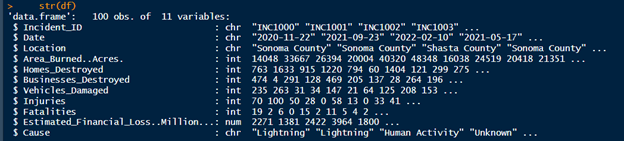
# Verify multiple data types
sapply(df, class)

# Ensure dataset supports generic methods
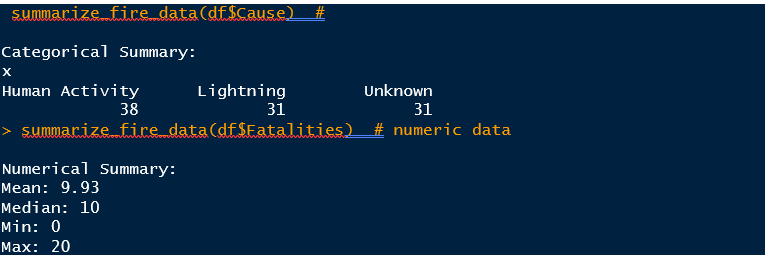
summarize_fire_data(df$Cause) # Works on categorical data
summarize_fire_data(df$Fatalities) # Works on numeric data
Since methods are dispatched dynamically, I confirm that a generic function is applicable. I did go overboard with the methods. See the code in Github. 😊 Here are the results:
How Do We Determine If Our Dataset Supports S3 and S4?
I conducted multiple tests to determine if our dataset could be structured as S3 or S4.
✅ Check If the Dataset is S3-Compatible (Lists and Attributes) is.list(df)

✅ Check If S4 is Supported (Explicit Class Definition Required)
isS4(df)

Since the dataset is not already an S4 object, I converted it using setClass().
✅ Use otype() from pryr to Confirm Object Types
library(pryr)
otype(df) # Returns “S3” since data.frame is S3

fireS3 <- wildfire_s3(df, 3)
otype(fireS3)

fireS4 <- wildfire_s4(df, 3)
otype(fireS4)

✅ Final Validation Using isS4() and class()
More 💡R Code: Github
These checks confirm that our dataset supports both S3 and S4!
S3 vs. S4: Examples for GitHub
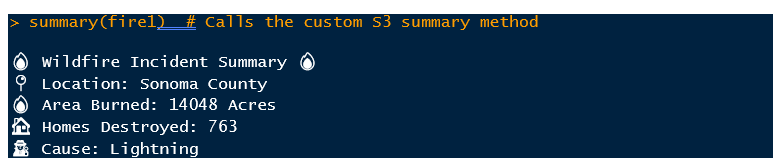
✅ S3 Example
# Define S3 constructor # Create an S3 object
💡 S3 R Code Solution: 📂 GitHub
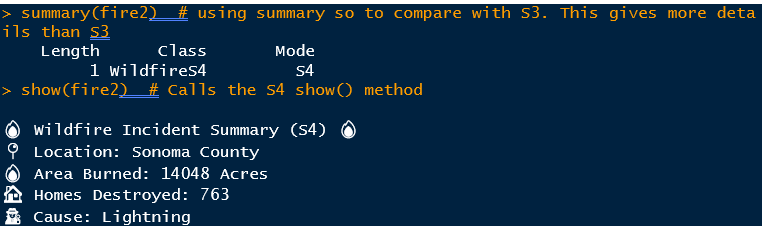
✅ S4 Example
# Define S4 class
# Define S4 constructor
# Create an S4 object
💡 S4 R Code Solution: 📂 GitHub
Final Thoughts: S3 vs. S4 Differences
| Feature | S3 (The Laid-Back System 😎) | S4 (The Strict Professor 👨🏫) |
| Flexibility | Very flexible, no formal structure | Strict rules, requires class definitions |
| Validation | No automatic checks | Enforces data type validation |
| Method Dispatch | Uses UseMethod() | Uses setGeneric() and setMethod() |
| Definition | Uses simple lists | Uses setClass() and slots |
| Ease of Use | Quick and easy to modify | Requires more setup but ensures structure |
| Best For | Fast prototyping and simple models | Complex applications that need data integrity |
I have determined that ✔️ Generic functions can be applied because our dataset has numeric and categorical data types. ✔️ S3 and S4 can be assigned because our dataset represents structured objects (wildfire incidents).
This project was a great deep dive into R’s object-oriented systems!
NOTE: 📂 Check out my full code on GitHub!
References:
Matloff, N. (2011). The art of R programming: A tour of statistical software design. No Starch Press. Chapter 9.
Leisch, F. (2014). S4 classes and methods. R Development Core Team. Retrieved from usflearn.instructure.com/courses/
Chambers, J. M. (1998). Programming with data: A guide to the S language. Springer.
Wickham, H. (2015). Advanced R. Chapman and Hall/CRC. Retrieved from http://adv-r.had.co.nz/
 Everyday Stat, Analytics & Python